Join us!

Current openings
We have two engineering vacancies available at the moment. Please consider applying!
Right now we do not have fully-funded positions for Ph.D. students and PostDocs. Please check again later.
If you have your own sources of funding, please get in touch with us.
You can also check out other positions in our department.
Research Engineer for OpenML (2 years) (will open soon)
Would you like to work on open source software full-time and make machine learning more accessible and reproducible? Join us to build the next generation of OpenML, a popular open science platform for sharing interconnected AI artifacts (e.g. datasets, models, and benchmarks) using open standards and structured APIs. OpenML serves over 300,000 users, has supported over 1,600 scientific studies, and won the Dutch Data Prize.
This project will help strengthen the impact and sustainability of OpenML, by:
- Modernizing Infrastructure to simplify deployment and streamline community contributions.
- Improving Open Data, enriching OpenML metadata with FAIR-aligned elements (e.g. data cards and model cards), supporting diverse data types and modalities, and allowing integration with other open science infrastructures.
- Enhancing User Experience through better interfaces and collaboration features.
- Engaging the Scientific Community, ensuring that the platform meets the evolving needs of the open science community.
You will focus primarily on task 1 and 2, specific responsibilities include:
- Update the technical infrastructure components of OpenML to more modern and contributor-friendly technologies.
- Enrich metadata by building on community standards such as Croissant, including quality metrics, DOI references, data provenance (e.g. data cards and model cards) and responsible AI metadata.
- Extend support for more data modalities (e.g. imagery, time series, text, and multi-modal data), and domain-specific open data formats (e.g., genomic data).
- Streamline data loading into AI tools to facilitate AI experimentation in many scientific workflows.
- Update developer tools and documentation to speed up the onboarding of new community contributors and streamline maintenance.
- Close collaboration with another hire for the project based in Leiden University that focuses on task 3 and 4.
We will provide you with an ideal environment for advanced AI research and collaboration. You will work directly with AMOR/e’s engineering team, including Pieter Gijsbers, Subhaditya Mukherjee, and Joaquin Vanschoren.
You will also be supported by project partners in Leiden University, the SURF supercomputing center, and the Dutch e-Science Center. Beyond that, you work together with the wider OpenML community, especially the core contributors, as well as the Croissant community (led by Google and the Open Data Institute), and developers from other AI platforms such as Hugging Face.
Research Engineer for OpenML (4 years) (will open soon)
Would you like to work on open source software full-time and make machine learning more accessible and reproducible? Join us to build a new international AI ecosystem around OpenML, a popular open science platform for sharing interconnected AI artifacts (e.g. datasets, models, and benchmarks) using open standards and structured APIs. OpenML serves over 300,000 users, has supported over 1,600 scientific studies, and won the Dutch Data Prize.
For this position, you will help seamlessly integrate OpenML with other Dutch and international infrastructures (e.g., SURF, NLeSC, Hugging Face) to transform it into a next-generation, unified platform for AI:
- Allow people to access datasets and models uniformly from various hosting infrastructures.
- Easily train and benchmark AI models transparently on scalable computational infrastructure.
- Organize all data and results automatically for easier reuse and better reproducibility.
Specific key tasks include:
- Redesign the OpenML platform architecture to streamline federation.
- Update the OpenML backend and APIs to implement integrations with other APIs (e.g. Hugging Face libraries, Harvard Dataverse) and compute infrastructure.
- Improve experiment tracking from AI tools (e.g., PyTorch), using a tracking API or callbacks, with a focus on global community collaboration and better reproducibility.
- Accelerate AI-driven research: support team-based, real-time collaboration, share reproducible results via permalinks in papers, track impact metrics (e.g., dataset reuse), integrate with code repositories (e.g., GitHub) and publishing platforms (e.g,. ArXiv).
- Continuous infrastructure improvement, incorporating community feedback, improving scalability and simplifying maintenance.
We will provide you with an ideal environment for advanced AI research and collaboration. You will work directly with AMOR/e’s engineering team, including Pieter Gijsbers, Subhaditya Mukherjee, and Joaquin Vanschoren.
You will also be supported by project partners in Leiden University, the SURF supercomputing center, and the Dutch e-Science Center.
Who we are looking for
We are seeking exceptional individuals who aspire to leave a mark on the world of machine learning and push humanity forward
- Fearless Explorers: Visionaries who dare to think big, embrace curiosity, and thrive on pushing the boundaries of innovation.
- Dedicated Builders: Innovators who turn ambitious ideas into reality, creating solutions with real-world impact.
- Empowered Leaders: Changemakers ready to unlock their full potential, inspire others, and define the future of machine learning.
We especially appreciate people who are curious and open-minded, self-driven and collaborative, kind and respectful, and who contribute to our shared passion for research and exploration. If you’re passionate about making a difference and pursuing excellence, we want you to be part of our journey.
How we will empower you
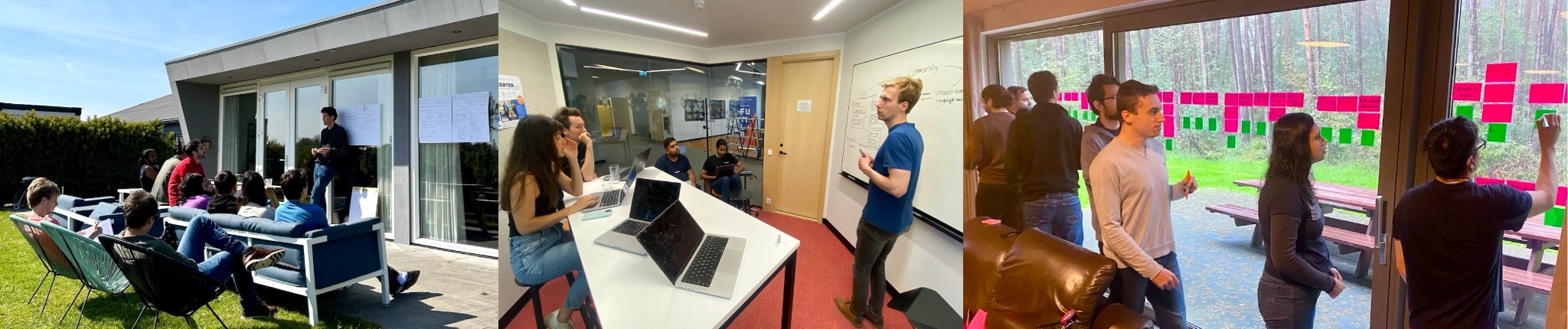
We cultivate an environment that inspires and supports world-class research. Our focus is on quality over quantity, encouraging innovative, blue-sky thinking while embracing openness, transparency, and learning from mistakes. Above all, we prioritize an excellent work-life balance, with minimal meetings, plenty of time for focused work, and numerous opportunities to learn and collaborate with one another.
Fully Funded for Success
All positions are fully funded, so you can focus entirely on your research and growth. PhD positions are always funded for 4 years. PostDoc and Research Engineer positions are usually for 2-4 years, with possibilities for extension. All positions come with a good salary determined on your experience and seniority, in accordance with the Dutch universities’ labor agreement.
World-leading research
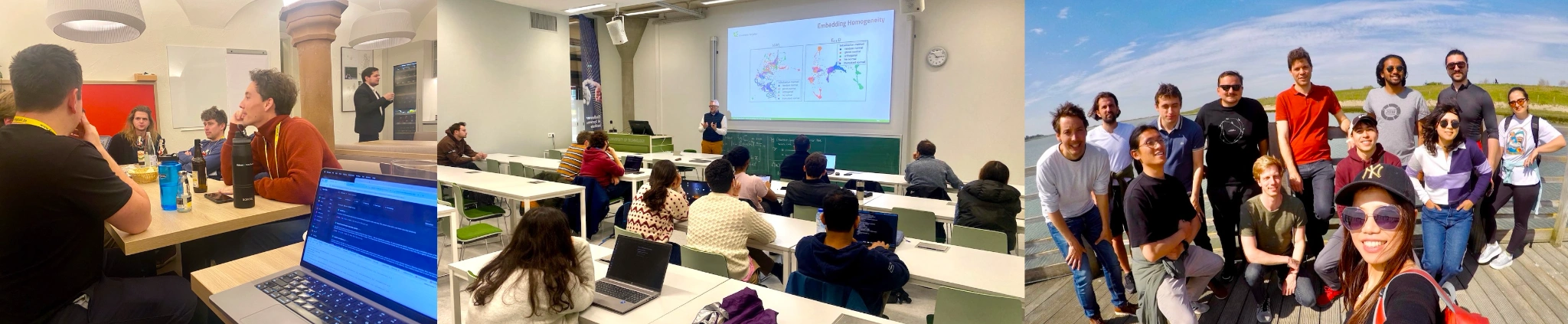
We change the world, together. We’re a tight-knit team of about 20 PhD’s, postdocs, and engineers working together to create real impact. You can find our work in top AI conferences and journals, including NeurIPS, ICML, CVPR, JMLR, and TPAMI, and we take pride in good engineering and open science, building AI tools used by hundreds of thousands of people.
Freedom to Study Deeply and Think Big
We don’t just follow trends — we set them. We encourage every team member to become a leading expert, think outside the box, and find novel avenues of research. We work on extremey efficient continual and meta-learning inspired by the human brain, we design AI models that design themselves using AutoML, we build platforms and create standards that enable research that wasn’t possible before, and even create new venues (e.g. NeurIPS Datasets & Benchmarks) to create new incentives and strengthen communities.
Purpose-Driven Research
Your work here will matter. Next to doing transformative fundamental research, we also leverage our insight to tackle real-world problems, in line with AI for good and sustainable development goals.
Excellent Career Prospects
Research labs and employers around the globe recognize the quality of our researchers, and we collaborate extensively with other leading research labs and organizations all over the world, such as Google, HuggingFace, and MLCommons.